 The Propaganda Files
Twitter Files #2: visibility filtering and secret blacklists
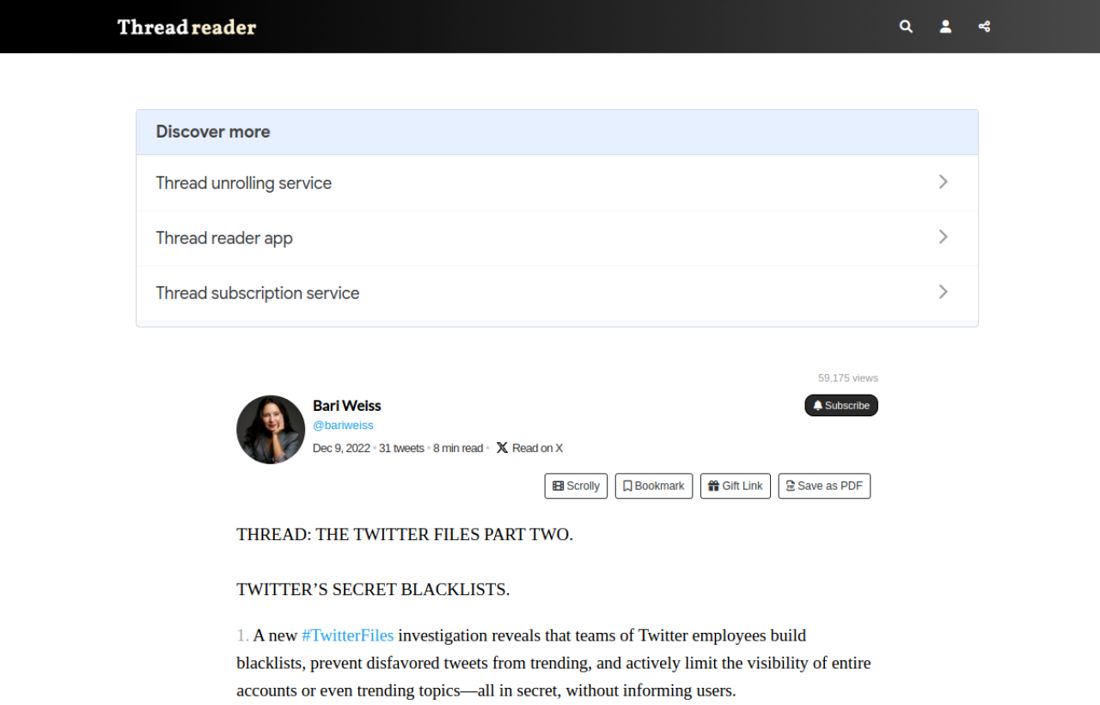
Bari Weiss's thread showed Twitter used 'visibility filtering' to limit the reach of specific accounts without telling them. Stanford's Jay Bhattacharya was on a 'Trends Blacklist,' Dan Bongino on a 'Search Blacklist,' and Charlie Kirk was set to 'Do Not Amplify.' A senior group called SIP-PES handled the most sensitive cases.
Every named example in the thread was a right-leaning or lockdown-skeptical account, though the full list of filtered accounts was never released.
What the record shows
Weiss reported that staff used 'Visibility Filtering' (VF) to block searches of users, limit tweet discoverability and keep posts off trending and hashtag pages. A senior employee called VF 'a very powerful tool.' Internal screenshots showed Dr. Jay Bhattacharya, a Stanford critic of COVID lockdowns, tagged 'Trends Blacklist'; Dan Bongino tagged 'Search Blacklist'; and Charlie Kirk tagged 'Do Not Amplify.' Decisions on politically sensitive, high-follower accounts went to 'Site Integrity Policy, Policy Escalation Support' (SIP-PES). Weiss contrasted this with Twitter's 2018 statement 'We do not shadow ban.'
In their words
“a very powerful tool”— Senior Twitter employee, describing visibility filtering (per Weiss) · source
“We do not shadow ban”— Vijaya Gadde and Kayvon Beykpour, Twitter (2018 blog, quoted by Weiss) · source
Twitter had publicly defined shadowbanning as making content invisible to everyone but the poster, which these labels did not do. Weiss did not disclose how many accounts were filtered or whether left-leaning accounts were also labeled, and former Twitter product head Kayvon Beykpour called the thread misleading.
Sources
- Bari Weiss, Twitter Files Part 2 (original thread)https://twitter.com/bariweiss/status/1601007575633305600?lang=en
- Twitter Files Part 2 (Thread Reader unroll)https://threadreaderapp.com/thread/1601007575633305600.html
- Fox News: Second Twitter Files reveals secret blacklistshttps://www.foxnews.com/media/elon-musks-second-installment-twitter-files-reveals-secret-blacklists-bari-weiss-reports
- Gizmodo: Twitter Files Part Two on shadow banninghttps://gizmodo.com/elon-musk-twitter-files-bari-weiss-part-two-shadow-ban-1849876635
- Wikipedia: Twitter Fileshttps://en.wikipedia.org/wiki/Twitter_Files