 The Propaganda Files
Dorsey tells Congress Twitter does not shadowban by ideology
In 2018 Twitter's leadership publicly denied shadowbanning, in a company blog post, a radio interview and testimony to the House Energy and Commerce Committee. Dorsey also told the committee an algorithm had unfairly filtered about 600,000 accounts from search auto-suggest. Internal documents released in 2022 showed Twitter used visibility-limiting tools it did not call shadowbanning.
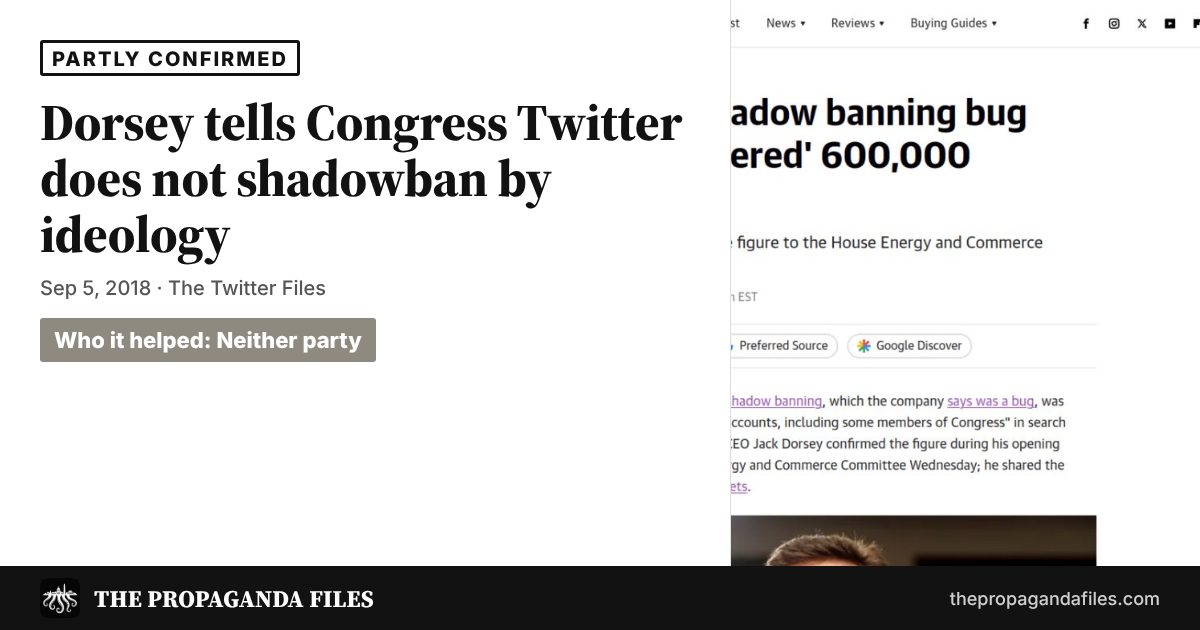
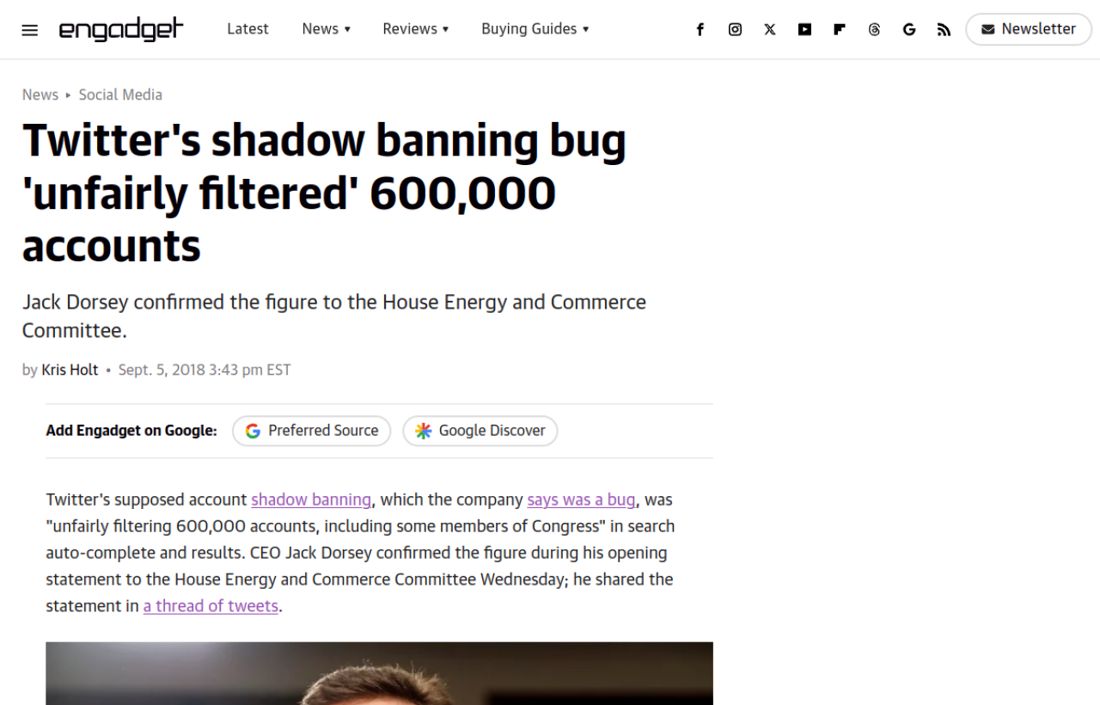
The 600,000-account filtering bug hit some members of Congress, and Twitter's own data showed no partisan gap in tweet views at the time, so the record does not show this error serving one party.
What the record shows
On July 26, 2018, Twitter's Vijaya Gadde and Kayvon Beykpour published 'Setting the record straight on shadow banning,' stating 'We do not.' The post defined shadowbanning narrowly, as making content undiscoverable to everyone except the poster. In an August 2018 radio interview with Sean Hannity, Dorsey said Twitter does not shadowban by political ideology or viewpoint. At the September 5, 2018 House Energy and Commerce hearing, Dorsey said 'our algorithms were unfairly filtering 600,000 accounts, including some members of Congress' from search auto-suggestions, and that the issue had been fixed. He testified that Twitter found no statistically significant difference in views of Democrats' and Republicans' tweets. In December 2022, Bari Weiss's Twitter Files thread documented 'Search Blacklist,' 'Trends Blacklist' and 'Do Not Amplify' labels used on specific accounts.
In their words
“We do not shadowban according to political ideology or viewpoint or content, period.”— Jack Dorsey, Twitter CEO (Hannity radio interview, Aug 2018) · source
“Our algorithms were unfairly filtering 600,000 accounts, including some members of Congress”— Jack Dorsey, Twitter CEO · source
“Favoring one specific ideology or belief goes against everything we stand for.”— Vijaya Gadde, Twitter legal/policy chief · source
Twitter's denials used a narrow definition of shadowbanning (total invisibility), and the 2022 documents show reduced reach, not total invisibility, so whether the 2018 statements were false depends on the definition. Twitter's own 2021 research found its home-timeline algorithm amplified right-leaning politicians and news outlets more than left-leaning ones in most countries studied.
Sources
- House Energy & Commerce hearing transcript, Sept 5, 2018 (docs.house.gov)https://docs.house.gov/meetings/IF/IF00/20180905/108642/HHRG-115-IF00-Transcript-20180905.pdf
- Engadget: Twitter's shadow banning bug 'unfairly filtered' 600,000 accountshttps://www.engadget.com/2018-09-05-twitter-shadow-banning-bug-accounts-jack-dorsey.html
- Engadget: Twitter again says it doesn't 'shadow ban' (links to the blog post)https://www.engadget.com/2018-07-26-twitter-shadow-ban.html
- Twitter blog: Setting the record straight on shadow banning (July 26, 2018)https://blog.twitter.com/official/en_us/topics/company/2018/Setting-the-record-straight-on-shadow-banning.html
- Washington Times: Dorsey on Hannity, 'We don't shadowban'https://m.washingtontimes.com/news/2018/aug/9/twitter-ceo-jack-dorsey-we-dont-shadowban-conserva/
- BNN Bloomberg: Republicans press Dorsey over shadow banninghttps://www.bnnbloomberg.ca/republicans-press-dorsey-over-twitter-s-shadow-banning-1.1133466
- The Next Web: Twitter research finds algorithms amplify right-wing voices (Oct 2021)https://thenextweb.com/news/twitter-research-finds-platform-algorithms-amplify-right-wing-voices